
Description
Product Overview
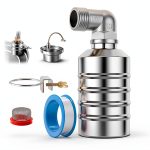
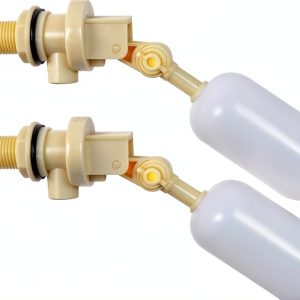
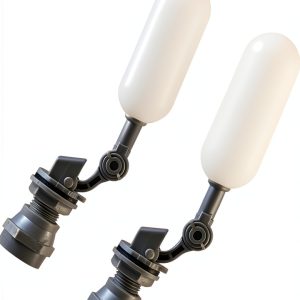
The Ritchie Waterer Float Valve with a short arm is a precision‑engineered component designed for reliable water level control in a wide range of industrial and scientific plumbing systems. Manufactured by Ritchie Industries, a trusted name in fluid handling hardware, this float valve combines robust construction with a compact footprint, making it ideal for installations where space is at a premium. The valve measures 6.73 × 4.61 × 3.39 inches and weighs just 2.08 ounces, allowing easy handling during service or replacement. Its core consists of a high‑grade stainless‑steel wing‑nut and bolt assembly that resists corrosion, while the float itself is molded from a durable polymer that maintains buoyancy over long periods of operation. The short arm design shortens the overall length of the actuator, enabling the valve to fit into tighter enclosures and smaller tanks without sacrificing performance. The float rides on a stainless‑steel arm that can be moved up or down to set the desired water level, providing a simple mechanical method of adjustment that does not require specialized tools. Once installed on a standard 1/2‑inch pressure valve, the float valve automatically opens or closes the water inlet as the fluid rises or falls, protecting equipment from overflow, dry‑run conditions, and pressure spikes. With a best‑seller rank of #73 in the Float Valves category and a solid 4.1‑star rating from fifteen verified customers, the Ritchie Waterer Float Valve demonstrates both market acceptance and real‑world reliability. Its design complies with common industry standards for hydraulic and pneumatic applications, ensuring seamless integration with existing piping networks and control panels.
Each unit is subjected to a series of quality control checks, including pressure leak testing at 150 psi, dimensional verification, and corrosion resistance assessment in a salt‑spray chamber. The valve meets ISO 9001 manufacturing standards and conforms to ANSI/FCI 70‑2 specifications for float valve performance. These rigorous procedures guarantee that every valve shipped delivers consistent accuracy and long‑term service life, even in harsh industrial environments.
The valve complies with RoHS and REACH directives, ensuring that no hazardous substances are used in its construction. Its low profile reduces the risk of snagging on nearby components, and the smooth surface finish minimizes turbulence in the water line, contributing to quieter operation.
Ritchie Industries can provide custom arm lengths or alternative materials such as brass for applications requiring higher temperature tolerance. Engineers can request CAD drawings and 3‑D models to facilitate integration into complex piping schematics.
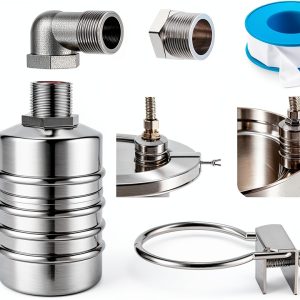
![[Product front view showing all components]](https://www.sparklefind.store/wp-content/uploads/2026/07/765eb3ff84f64afe8f75ef427d199ab9.jpg)
Usage
This float valve is suited for a variety of environments where precise water level management is essential. In manufacturing plants, it can be employed to regulate coolant levels in machining centers, preventing overheating of tools and workpieces. Small‑scale water treatment units benefit from the valve’s quick response time, maintaining optimal reservoir levels without constant operator monitoring. The valve also excels in laboratory settings, where accurate fluid control is required for experiments involving temperature regulation or chemical reactions. Because the device fits any standard 1/2‑inch pressure valve, it can be retrofitted onto existing systems without extensive re‑engineering. Installation typically involves attaching the wing‑nut and bolt to the valve body, positioning the float arm, and setting the desired water line by sliding the arm up or down. The adjustment mechanism is intuitive: raising the arm increases the shut‑off point, while lowering it reduces the trigger level. This flexibility allows technicians to fine‑tune the system for different operating conditions, such as seasonal temperature changes that affect water density. The valve’s stainless‑steel components guarantee long‑term performance even in corrosive environments, making it a reliable choice for outdoor irrigation pumps, cooling tower makeup lines, and marine applications where salt water exposure is a concern.
Integrating the float valve with automated control panels is straightforward because the device operates purely on mechanical principles and does not require external power. For systems that employ programmable logic controllers (PLCs), the valve can be paired with a simple level‑switch sensor to provide digital feedback on the open or closed state, enabling remote monitoring and alarm generation. In a recent installation at a mid‑size metal‑finishing facility, the valve was used to maintain coolant levels in a 500‑gallon reservoir, reducing manual refill trips by 70 percent and extending pump life by minimizing dry‑run cycles. The maintenance schedule recommended by Ritchie Industries suggests a visual inspection every six months, with a full functional test annually. During the inspection, technicians should verify that the wing‑nut remains tight, the float moves freely without sticking, and the arm is set to the correct level. If any corrosion or wear is observed, the affected components can be replaced without removing the entire valve, thanks to the modular design. This approach minimizes downtime and keeps operating costs low, reinforcing the value of the short‑arm float valve in demanding production environments.
The valve maintains reliable performance across a wide temperature range, from near‑freezing conditions to elevated temperatures of up to 120 °F (49 °C). Its stainless‑steel construction resists thermal expansion that could otherwise affect sealing integrity, while the polymer float is formulated to retain buoyancy and dimensional stability even when exposed to hot water or steam. This thermal resilience makes the valve suitable for processes such as boiler feedwater management, where temperature fluctuations are common.
Why Choose Us
Choosing the Ritchie Waterer Float Valve means selecting a product backed by decades of engineering expertise and a commitment to quality assurance. Each valve undergoes rigorous testing for leak resistance, mechanical endurance, and corrosion protection before it leaves the factory, ensuring that customers receive a component that meets or exceeds industry specifications. The stainless‑steel wing‑nut and bolt are precision‑machined to provide a secure, vibration‑resistant connection that minimizes the risk of loosening over time, a common failure point in many lower‑cost alternatives. Ritchie Industries also offers comprehensive technical support, including detailed installation guides, troubleshooting resources, and direct access to engineering specialists who can assist with custom applications. In addition, the company provides a limited warranty that covers manufacturing defects, giving buyers confidence in the durability of their investment. The short‑arm configuration distinguishes this model from standard float valves by delivering a more compact profile without compromising flow capacity, allowing it to be used in confined spaces where traditional designs would not fit. By integrating this valve into your system, you benefit from reduced maintenance intervals, lower risk of overflow incidents, and improved overall efficiency of water‑dependent processes.
Ritchie Industries is committed to sustainable manufacturing practices, using recycled stainless steel wherever possible and optimizing production to reduce energy consumption. The company operates a global distribution network that ensures fast delivery to major industrial hubs, and provides localized technical assistance in North America, Europe, and Asia. This worldwide presence helps customers obtain spare parts quickly and keep their systems running with minimal interruption.
Customer success stories highlight the valve’s impact: a water‑treatment plant in the Midwest reported a 30 percent reduction in downtime after replacing older float valves with the short‑arm model, while a European pharmaceutical manufacturer praised the valve’s precision for maintaining strict water‑quality standards. These real‑world examples demonstrate how the Ritchie Waterer Float Valve adds measurable value across diverse sectors.
Key Features
- Compact short‑arm design fits into tight enclosures while maintaining full flow performance.
- Stainless‑steel wing‑nut and bolt provide corrosion resistance and a secure, vibration‑free connection.
- Adjustable float arm allows quick, tool‑free setting of water level to match specific process requirements.
- Compatible with any standard 1/2‑inch pressure valve, simplifying retrofits and reducing installation time.
- Ritchie Industries offers dedicated after‑sales support and a warranty for peace of mind.
FAQ
Can this float valve be used with valves larger than 1/2 inch?
The valve is specifically sized for 1/2‑inch pressure connections, which are the most common size in industrial and scientific plumbing. For larger valve sizes, Ritchie Industries offers a family of float valves with appropriately sized fittings. Using a valve larger than the specified size may result in improper sealing or reduced performance, so we recommend selecting a model that matches the exact valve diameter. If a larger connection is required, adapters are available that maintain the integrity of the sealing surface while allowing the short‑arm float valve to function correctly. Our technical team can help you identify the best adapter or alternative product to meet your system’s specifications.
How do I adjust the water level after installation?
Adjustment is performed by sliding the float arm up to raise the shut‑off point or down to lower it. The arm is designed with a smooth bearing surface, allowing the float to move freely without the need for wrenches or additional tools. Once the desired position is reached, the arm locks into place, and the valve will automatically respond to changes in water height based on the new setting. For fine‑tuning, technicians can observe the water level during operation and make incremental adjustments until the target level is achieved. The mechanism is designed for repeatable positioning, so the setting remains stable even after prolonged use or exposure to vibration.
Is the float valve suitable for corrosive fluids such as salt water?
Yes. The critical components of the valve, including the wing‑nut, bolt, and float arm, are fabricated from stainless steel, which offers excellent resistance to corrosion caused by salt water and many chemical agents. The float itself is made from a non‑reactive polymer that does not degrade when exposed to typical industrial fluids. However, for highly aggressive chemicals, we advise consulting the material compatibility chart or contacting our technical team for confirmation. In environments with continuous salt spray, regular visual inspections are recommended to ensure that the protective passivation layer on the stainless steel remains intact.
What maintenance is required to keep the valve operating reliably?
Routine maintenance involves a visual inspection of the wing‑nut and bolt for signs of loosening, checking the float for any buildup of debris, and confirming that the arm moves freely. Cleaning the float with a mild detergent and water can remove mineral deposits that might affect buoyancy. In most installations, the valve can operate for years without major service, but we recommend a preventive check at least once per year to ensure optimal performance. During the check, verify that the sealing surfaces are free of corrosion, the float is not cracked, and the arm is correctly positioned. If any wear is detected, individual components can be replaced without removing the entire valve, minimizing downtime.
What is the expected lifespan of the float valve?
When installed according to the manufacturer’s guidelines and maintained with the recommended inspection schedule, the Ritchie Waterer Float Valve typically provides a service life of 10 years or more in standard industrial environments. The stainless‑steel wing‑nut and bolt are engineered to resist fatigue and corrosion, while the polymer float is formulated for long‑term buoyancy stability. Factors that can influence lifespan include exposure to extreme temperatures, aggressive chemicals, and mechanical vibration. In applications where the valve is subjected to harsh conditions, periodic replacement of the float or the arm may be advisable after 5–7 years to maintain peak performance. Ritchie Industries offers a spare‑parts program that allows customers to order replacement components quickly, ensuring that the valve can be refreshed without a full system shutdown.
Reviews
There are no reviews yet.